
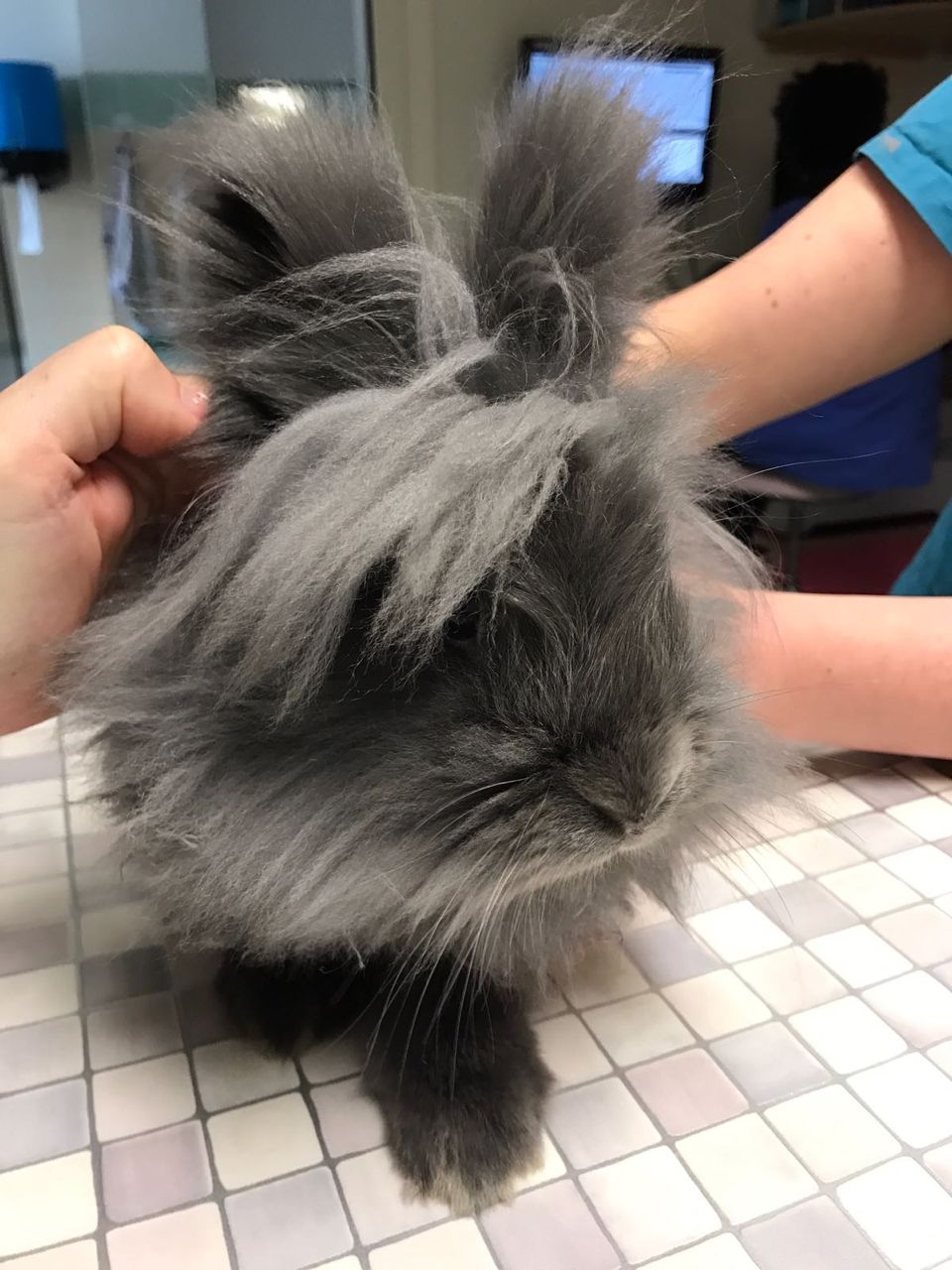
The very broad term ‘rabbit’ covers certain long-eared lagomorph animals. They are herbivores.
|
 |
| Class | Mammals |
| Order | Lagomorphs |
| Family | Leporidae |
| Genus | Oryctolagus |
| Species |
Oryctolagus cuniculus (the domestic, wild or European rabbit) Sylvilagus spp. (American cottontail rabbits) |
The rabbit is not a rodent, because it does not have the same number of upper incisors, nor the same number of toes!
Biological and physiological features
A rabbit’s life expectancy is between 6 and 10 years; the longevity record is 15 years. Its temperature ranges from 38.2 to 39.4 °C. It is normal for a rabbit’s heart to beat fast, on average 270 beats per minute. It eats small amounts 2 to 3 times a day. It practises caecotrophy (re-ingesting the soft, pale droppings for better vitamin absorption). Rabbit urine naturally has a strong smell. Its colour range is wide and can shift from a cloudy, yellowish white to brown or orange, and sometimes reddish-brown.
The dental formula is made up as follows:
|
Incisors |
Canines |
Premolars |
Molars |
|
|
Upper jaw |
2 |
0 |
3 |
3 |
|
Lower jaw |
1 |
0 |
2 |
3 |
REPRODUCTION
As for reproduction, males reach puberty between 3 and 6 months. Their testicles are mobile. Females are pubertal between 4 and 8 months; their uterus has 2 horns. The breeding season lasts all year round. Pregnancy is 30–32 days. Dwarf does can have 2 to 5 young per litter, and so-called large-breed does can have up to 10 young per litter. To feed all these little ones, they have 4 pairs of teats.
Why neuter and spay rabbits?
- Neutered rabbits are healthier and live longer than unneutered ones.
- Neutered rabbits make better companions.
- Troublesome behaviours are done away with.
- Neutered rabbits do not add to the problem of rabbit overpopulation.
- Neutered rabbits can have playmates in complete safety.
- Spayed females no longer risk endometritis.
- Neutering and spaying rabbits have become safe procedures when carried out by a vet who specialises in rabbits.
A rabbit should live with one or more others. The ideal is a neutered male–female pair. If you choose to adopt 2 rabbits of the same sex, take them from the same litter.
It marks its territory by rubbing the bridge of its nose or its chin on the furniture. For a good life, the rabbit’s cage should be in a quiet spot where the room temperature stays between 18°C and 20°C. The rabbit is sensitive to changes in its environment. The cage should measure at least 2 m², ideally 4 m² for 2 to 4 rabbits. It can also live free-range.
For bedding you can use hay, straw, bark, or shop-bought litter. It simply needs to stay dry. You can add pieces of wood or branches (hazel, untreated fruit trees) to the box to wear the teeth down.
Hiding places or spots to retreat to are essential, as are resting surfaces.
Feeding
The rabbit is a herbivore; its diet must be made up of at least 70% hay, which wears down the teeth and aids good digestion. The rabbit absolutely must have it available at all times.
Greens should be given every day (8 to 10% of the rabbit’s body weight). Favour dark-green leaves, which file the teeth down better.
- Examples of greens: aromatic herbs, celery sticks, radish and turnip leaves, carrot tops, endive, dandelion, carrots, pepper, oak-leaf lettuce.
Fruit and treats should be given at most 1 to 2 times a week. Rabbit pellets must be rationed and never given ad lib. Extruded grass products are worthwhile; seeds are to be avoided entirely.
You must not feed it:
– sugary foods, chocolate
– dry bread
– sweets
– onion
– potato
– buttercup
– foxglove
– autumn crocus
– poppy
and houseplants.
For drinking, it needs clean water, changed every day.
HANDLING
One hand under the chest and one under the bottom. But the best way to pick it up is to take it firmly by the skin of the shoulders or the back. What you must not do is pick it up by the ears or by the hind legs. More nervous individuals can be wrapped in a towel. Small rabbits can be held in both hands under the abdomen. For transport, place the rabbit on your forearm.
Why neuter and spay rabbits?
- Neutered rabbits are healthier and live longer than unneutered ones.
- Neutered rabbits make better companions.
- Troublesome behaviours are done away with.
- Neutered rabbits do not add to the problem of rabbit overpopulation.
- Neutered rabbits can have playmates in complete safety.
- Spayed females no longer risk endometritis.
- Neutering and spaying rabbits have become a safe procedure when carried out by a vet who specialises in rabbits.
Back to top