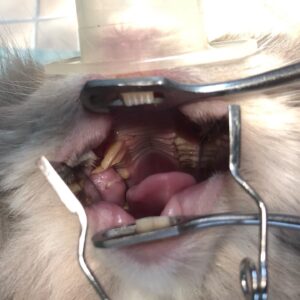
Dental malocclusion in rodents and rabbits
Dental malocclusion in guinea pigs, chinchillas and rabbits is probably one of the main reasons they are brought to the vet.
The problems it causes appear after several months of life and can affect the incisors (at the front, in plain view) or the molars (at the back, hard to see). The teeth grow continuously, and if they grow crookedly they develop spikes or bridges between them that injure the lining of the mouth and cause sores, hamper the movement of the tongue, or form a mechanical blockage.
The warning signs are as follows:
- The animal sorts through its food, drools, stops eating and/or drinking altogether, loses weight, may develop digestive trouble, or sometimes an abscess on the cheeks or lower jaw.
- A rodent or rabbit that stops eating is in a critical state. Its sophisticated digestive system cannot survive a prolonged fast for long. There is no waiting several days before showing it to a vet, especially if it has stopped eating altogether.
- When the incisors are behind the malocclusion, the outlook is better. Cutting them under general anaesthetic with an electric burr is the neatest way to shorten them, but the method of choice for erratic incisors remains simple extraction. The rabbit — the species most often affected by this type of malocclusion — then feeds perfectly normally afterwards.
- When the molars are responsible, their erratic growth can show up in a number of ways. A precise diagnosis can only be made under anaesthetic. Spikes or bridges will need trimming, and sometimes abscesses are found which are, however, very hard to clear. These abscesses are often very aggressive and can invade the bone. The aim is to excise them in full, along with the tooth or teeth responsible. An X-ray is often essential. The outlook for these abscesses is guarded.
X-rays of the head, even in a healthy rodent or rabbit, can generally reveal a malocclusion. Predicting whether it is likely to cause problems down the line is more difficult.
The best prevention, as a rule, is a diet rich in hay with less seed and grain. Seed mixes are often preferred because they are tasty, but hay remains the staple food that should be available at all times, to guard as well as possible against the problems that follow from malocclusion — and against digestive problems too.
The second thing is to avoid breeding from an animal with malocclusion, because this defect is passed on to its offspring.