
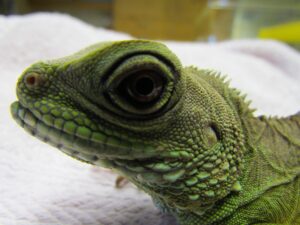
 A reptile consultation at the AuFuret veterinary practice
- When should you see a vet?
- Transporting a snake
- Handling and restraint
- The clinical examination
- Zoonoses
Keeping reptiles is a hobby winning over more and more enthusiasts the world over. Their numbers have risen sharply over the past decade, and they are taking up an ever greater place within the wider family of exotic pets. Yet these animals are especially fragile, wholly dependent on their surroundings, and often weakened by living conditions ill-suited to their vital needs.
When should you see a vet?
Watching a snake closely and regularly can help you pick up the early warning signs that may put your animal’s life at risk.
A VETERINARY VISIT IS RECOMMENDED IN THE FOLLOWING CASES:
- A lasting loss of appetite (anorexia). Many causes are possible, chiefly husbandry mistakes — the set-up should always be checked first. The move into captivity is often to blame too in wild-caught snakes.
- Stunted growth or weight loss. Possible causes: too little food, parasites, digestive trouble, chronic dehydration, cancer.
- Unusual listlessness (a problem with warmth and body temperature, lethargy).
- Suspicious lesions in the mouth (stomatitis). Causes: weakened defences, stress, poor general condition, poor hygiene.
- Heavy drooling (pneumonia or stomatitis).
- Burns (a snake roaming free in a flat, an unsuitable or badly placed heat source), wounds (bites from prey).
- Other lesions on the belly scales (septicaemia, blister disease). Causes: humidity too high, a poorly kept terrarium, waterlogged flooring.
- A lump appearing under the skin (abscess, tumour, parasites).
- Regurgitation.
- Diarrhoea.
- Abnormal postures.
- Discharge from the nostrils (rhinitis, stomatitis).
- Shedding problems. Causes: humidity too low, an unreachable water bowl, mites, a wound, and so on.
- Clouding of an eye.
- Baths that are more frequent or longer than usual.
- Itching.
- External or internal parasites (mites).
- Swelling of part of the body (constipation, egg binding, parasites, tumour).
Transporting a snake to the vet
So as not to skew the clinical examination, the owner should be told what precautions to take when moving their snake: keeping the temperature strictly right for that particular reptile — so, carrying it in a cloth bag placed inside a thermally insulated container with hot-water bottles, and checking the temperature with a thermometer. The average transport temperature is generally between 28 and 32°C.
Handling and restraint
Restraint is carried out calmly, in a room warmed up to the animal’s preferred body temperature (its mean preferred temperature). Gloves are best avoided, as the loss of the sense of touch can cause injuries. A careful wash of the hands replaces latex gloves.
Picking the animal up:
A fairly placid snake is grasped just behind the head, with one or two hands depending on its size. The thumb rests on the skull and the other fingers under the head. If the snake is aggressive, the head is steadied with a restraint hook before being taken hold of. The rest of the body must be supported — allow one person per metre of snake.
The clinical examination
The clinical examination has three parts. First, gathering the history: the living conditions and environment, the diet, the heating set-up, whether the animal lives alongside others, and so on. Second, observation from a distance, through the terrarium or on a surface that will not harm the animal. This lets you watch and listen to the breathing movements, but also gauge how lively the animal is, the movements of its forked tongue, how it holds its head, any deformities of the body, and the look of its skin.
The snake is then weighed, measured and sexed.
These first two parts of the consultation are usually the most important and the most revealing!
Third, the close-up examination:
- Looking at the scales, the stage of shedding, the state of hydration and body condition, and any external parasites, wounds, masses, hemipenal pockets, the supraocular scale, the nostrils and the rostrum.
- Then opening the mouth to look at the oral cavity, the choanae, the mucous membranes and the teeth.
- Listening to the heart and lungs (ideally with an Ultrascope).
- Feeling the coelomic cavity and assessing the organs. Take care — there is a risk of regurgitation after a recent meal.
- Where needed, further tests: droppings, blood, fluid samples, and so on.
A word about zoonoses (animal diseases that can pass to humans and the other way round), or how to keep the risks to a minimum around reptiles
- Wash your hands thoroughly with warm water and soap, every single time, after handling a reptile or touching anything in the terrarium.
- Do not set up a terrarium in a room used for eating or storing food (kitchen, living room).
- Disinfect the whole terrarium regularly with bleach (while doing so, wear single-use gloves and, if you can, a face mask, and never use kitchen utensils for this cleaning). Terrarium-specific disinfectants are also on the market.
- Never clean the water bowl or the decor items in the kitchen or bathroom sink. Set aside one particular spot for it.
- Do not eat, smoke or drink while handling a reptile or cleaning its terrarium.
- Never kiss a reptile! In any case, it is far from certain it enjoys that sort of show of affection.
- Advise against handling by children, and by anyone who is immunocompromised (chemotherapy, HIV, hepatitis, and so on).
- Avoid any direct contact with other pets living under the same roof.
- Always keep an eye on any bite or scratch wound caused by a reptile.
A handy, inexpensive little book by Lionel Schilliger, “Allo véto! 100 questions/réponses sur les reptiles”, éditions Philippe Gérard, ISBN 2-912521-13-0.