
- Origins
- Classification
- Biological and physiological features
- Housing and husbandry
- Common conditions
Origins
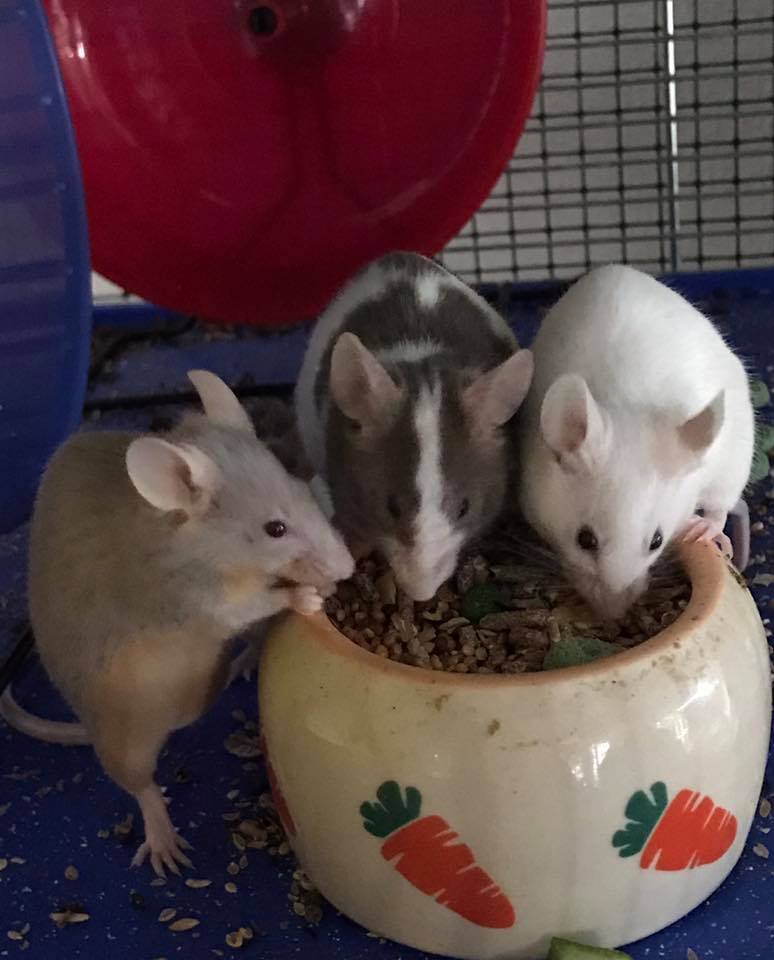
Traces of mice go back to the Neolithic. They originate from Asia and the Near East and colonised Europe by sea from the 17th century onwards. They were then used as laboratory animals. Their original colour is grey. Alongside the white mouse, there are colour mutants: solid colours with markings, black-and-tan, grey chinchilla. There are also long-haired mutants.Classification
| Class: | Mammals |
| Order: | Rodents |
| Suborder: | Sciurognaths (Wilson and Reeder), or myomorphs |
| Family: | Muridae |
| Subfamily: | Murinae |
| Genus: | Mus |
| Species: | musculus |
| Common name: | Domestic mouse |
Biological and physiological features
- adult male weight: 20–40 g.
- adult female weight: 25–40 g.
- total length: 14.5–18.5 cm
- tail length: 7–9.5 cm
- 4 toes on the forelimbs and 5 on the hindlimbs
- dental formula: 16 teeth
upper jaw 1 0 0 3 I C PM M lower jaw 1 0 0 3
Biological parameters
- In the wild: you can dig it a burrow or make it a nest of grass
- Way of life: the mouse is mostly active at dusk and at night, and this all year round
- Social system: they form small family groups. Keeping them singly is prohibited.
- Body temperature: 36.5–38°C
- The mouse does not hibernate
- Lifespan: 2 to 3 years
Reproductive physiology
- Age of sexual maturity: male 2 months, female 1.5 months
- Breeding season: all year round
- Cycle length: 4–5 days
- Type of ovulation: spontaneous
- Gestation length: 19–21 days
- Newborns open their eyelids at 13 days
- Number of young per litter: 7–10 young
- Number of litters per year: 4–8
- Weight at birth: 0.5–1.5 g
- Age at weaning: 21–28 days
- Number of pairs of teats: 5 pairs
Living environment
The cage must measure at least 30×60, i.e. 0.18 m² for 2 mice, plus 0.05 m² per additional mouse. For 2–5 mice, at least 0.5 m² of floor area, with a minimum height of 60 to 100 cm. In the absence of a cage, a large terrarium can be used. Hemp or maize can be used as bedding; it must be changed every week. Mouse urine gives off a strong smell, especially from the males. Accessories such as a wheel, a trapeze, a ladder, hiding places and hay or uncoloured kitchen paper for nest-building can be added to the cage.
A suitable place to put the cage:
- temperature: 19–21°C
- humidity of 30–70%
- lighting period: 12 hours
- ammonia level <10 ppm
Feeding
The mouse is an omnivore that eats less than 5 g of food a day. It should be given a complete seed mix containing 20–24% protein, or home-made rations with vegetables (lettuce, carrots, endives), fruit, seeds, and a little white meat, hard-boiled eggs and cheese, with water to drink freely available. And something to gnaw on (branches of beech, hazel or untreated fruit trees).
Handling
You should hold the mouse with one hand on the skin between the ears and the other hand at the base of the tail. Avoid the very tip of the tail, which may be left between your fingers.Common conditions
Skin conditions
- Dermatophytoses: rounded patches of hair loss. They can be passed on to people.
- Mange, with hair loss marked by crusts and pruritus (intense itching).
- Pseudo-mange, with localised crusted lesions.
- Mousepox, also called ectromelia, marked by the loss of toes and the tail as well as swelling of the face.
- Hair loss of nutritional origin, seen with biotin deficiency.
Respiratory conditions
- Mycoplasmosis, marked by suppurative rhinitis, chronic pneumonia and middle-ear infections.
- Pneumonia caused by the “Sendai” virus, fatal in baby mice under 12 days old.
Digestive conditions
Three types of diarrhoea may be encountered:
– The first is of viral origin. It is usually the mouse hepatitis virus, but it can be fatal in newborn mouse pups.
– The second is of bacterial origin (salmonellosis or colibacillosis).
– The third is of parasitic origin. There can be several parasites, such as protozoa, nematodes or indeed cestodes.
In the mouse there is yet another digestive disease, called Tyzzer’s disease. This disease mainly affects the intestines and the liver.
Other conditions
- There is a disease whose scientific name is lymphocytic choriomeningitis, which is transmissible to people.
- Conjunctivitis of bacterial origin.
- Mammary abscesses and tumours.
- In the male mouse, watch the preputial glands and the bulbo-urethral glands, which can become infected and can lead to the formation of mucous plugs that block the urethra.
Zoonoses
- salmonellosis
- lymphocytic choriomeningitis
- gastrointestinal parasites (tapeworms)