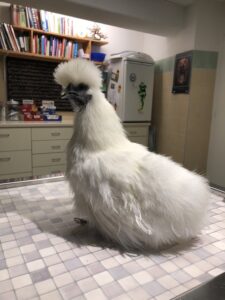
NAC stands for ‘nouveaux animaux de compagnie’ — new companion animals (exotic pets).
This abbreviation, coined in the 1980s by a vet in Lyon, covers every companion animal that is not a dog or a cat. So it includes rabbits just as much as iguanas or parrots. In short, this group takes in small mammals, rabbits, rodents and ferrets, as well as reptiles, birds, fish, amphibians, arachnids, insects, and so on.
Rodents are therefore NACs too; they include guinea pigs, chinchillas, rats, mice, hamsters, gerbils, degus and Korean chipmunks… The rabbit is not a rodent in the strict sense, but a lagomorph.
The line between companion animals and wildlife is sometimes hard to draw. For example, our local hedgehog belongs to native wildlife and may not be kept without a cantonal permit. Then there are Madagascar hedgehogs, which belong to their own local fauna — exotic to us — yet are kept as a NAC in our part of the world. Another example: the guinea pig has long been one of our companion animals, and yet in Latin America its only value as a domestic animal is culinary.
It is these cultural and geographical differences that lead the authorities to impose certain measures, including firm legislation with keeping permits that depend on the species and its size. Some animal species also fall under CITES rules, particularly where trade and the crossing of borders are concerned.
Here are a few points to keep in mind before adopting or buying an animal of exotic origin:
- Check its origin: it must not come from the black market
- Never buy an animal abroad (while on holiday, for instance) and smuggle it back home. You take part in an unregulated market, and on top of that you import far more trouble than pleasure (illegality, disease, cost, the animal’s suffering — in short, frequent euthanasia at the end, plus a fine)
- Check the permits required, and the equipment needed for its welfare
- Insist on the invoice: always ask for one and keep it
- Finally, something worth pondering: for some animals, mainly exotic ones, it is well known that intolerable captures take place — for example the massive dynamiting of coral reefs to catch certain fish, or unregulated captures. What is more, heavy losses (sometimes 50 to 80%) occur during transport to the country where the animals will be sold…
Do not take part in dubious trafficking of animals of uncertain origin!
And where is the pleasure in watching an animal starve itself to death in a cage because it was caught in the wild, however beautiful it may be? It risks wasting away so fast that its beauty proves very short-lived — unlike the hole in your wallet or the weight on your conscience.
That is why, despite the ‘fashions’ for the unusual, the more classic rodents, ferrets and other long-domesticated NACs will happily always keep the public’s favour.
As a general rule, a veterinary check before — or at least after — buying can be helpful for keeping an eye on the animal’s state of health.
The OSAV (Swiss Federal Food Safety and Veterinary Office, FSVO) website provides information on CITES standards, on the rules governing imports, the keeping of animals and trade in Switzerland, with keeping permits being issued by the cantonal authorities.
OSAV website: www.blv.admin.ch
CITES website: https://www.cites.org/
Are there any ‘real’ NAC specialists? Training in Switzerland
Veterinary studies in Switzerland do not cover the subject of NACs, being limited to dogs and cats, on top of cattle, sheep, goats and horses. A guinea pig or a rabbit may be touched on briefly, but no more than that.
Elsewhere in Europe, interest varies from one country to another, and it is often the countries of Central Europe that most frequently offer courses specifically devoted to NACs.
Swiss vets who are interested in training on NACs therefore undertake it of their own accord after their studies, and often have to turn to foreign continuing-education groups, or even to European or international continuing-education bodies.
At present, however, there is no specialist qualification in the strict sense of the term, awarded by a recognised training body. People speak of a ‘NAC specialist’ in everyday language, but the title as such should not be used and is misleading.
The same problem is found, incidentally, with other areas of interest or additional services offered by the vet: genuine recognised specialist titles are still relatively rare.
In Switzerland, vets are often willing to give information about their fields of service or — as with reptiles or ferrets, when they do not see these species themselves — about fellow colleagues who might.
Of the two veterinary faculties, Bern and Zurich, it is mainly Zurich that hosts a section for exotic animals, to use the German terminology.